Wednesday, October 12, 2005

Improvisation and Bureaucracies

Leadership style plays a huge role in the success or failure of an organization. IMHO, the best leadership style is to create a clear purpose and provide a strong guiding philosophy of how to make decisions for the good of the endeavor, then turn people loose.

From the standpoint of systems theory, improvisation is what makes life possible. In natural systems, the needs and environment of the system impose operating constraints on the subsystems, while allowing the subsystems considerable freedom to optimize within those limits. Within the rules, subsystems are capable of a wide range of actions and adaptations: just consider the incredible variety of life on this planet!

Arguably, some environments and rule sets are better than others for encouraging life or economic activity. The genius of capitalism is that the rules encourage people to find a niche and create more wealth. The idiocy of communism is that the elite seek to control every aspect of society and the economy. Communists aren't the only idiots either. Consider the mullahs, writes Michael Ledeen:
The tyrannical Islamofascists obviously despise and dread their people; otherwise they wouldn’t be constantly seeking new ways to make sure there is no independent thought and certainly no independent action. All those madrasas, for example, are extended experiments in what used to be called "rote learning." The children sit around and memorize the Koran and the sayings of the prophet, blessings be upon him. But, unlike the schools in the civilized world, nobody ever asks anybody else what he thinks about anything.

In a world like that, several things happen. Above all, creative activity ceases to exist, since culture depends on advancing knowledge and improving understanding. Neither of these interests the clerical fascists who rule the terror countries. They want good little Muslim androids, who will accept the preposterous belief that all knowledge was acquired several centuries ago and that man’s only worthwhile intellectual activity is to imbibe that knowledge in order to recite it when called for.

Large organizations, including government bureaucracies, can encourage or stifle innovation by dint of the corporate culture and leaders' style. Arnold Kling, at TechCentral Station, writes in "The Planning Illusion:"
I think that people have a tendency to put too much faith in centralized planning, and they do not have sufficient regard for decentralized improvisation. The more ambiguity that exists in a situation--because of its novelty, uncertainty, and the absence of critical information--the more that it favors improvisation over planning. [...]

When something goes wrong, there is a natural desire to blame a lack of planning. In fact, with hindsight, it is always possible to come up with a plan that would have worked better. I would refer to this as the planning illusion. This illusion causes a number of problems.


First, the planning illusion leads to the syndrome known as "planning for the last war." Organizations develop a set of operating strategies that are based on theories that are outdated, or just completely misguided.


Second, faith in planning causes organizations to become overly centralized. Information from peripheral sources is ignored. Flexibility for field-level decisionmaking is denied.


Finally, faith in planning leads people to believe that government has a solution for every problem. In many cases, better approaches emerge from decentralized improvisations.
It's worth a read, along with the companion piece, "The Impossibility of 'Planned Improvisation'."

Related post: Nimble Bureaucracies

Thoughts on the Miers Nomination

I haven't posted in a while, because I've had massive writer's block on this topic. But here goes:

I don't have a strong opinion about the nomination of Ms. Miers to the Supreme Court, but I am discomfited by the wailing and gnashing of teeth about this "stealth" candidate. People had the same complaint about John Roberts too! Overall, I'm much more swayed by the enthusiastic support of her colleagues than I am by criticism from those who don't know her.

As a manager, I think that President Bush made a wise choice to nominate a person whose talents, experience, and training compliment those of the sitting Justices. I agree with Hugh Hewitt that the last thing SCOTUS needs at this point is another legal scholar! (Hugh has lots and lots of posts, and Radioblogger has lots and lots of transcripts.)

Last week, Orin Kerr at The Volokh Conspiracy rounded up conservative pundits' dismay, and summarized the four basic arguments being made:
If you're right of center and support the nomination: You should approve of the Miers nomination because 1) the President has picked Miers, and you can trust him; 2) several prominent conservatives like James Dobson and Leonard Leo support the nomination, and they must know something you don't; and 3) the loudest conservative critics of the Miers nominations are the annoying ivory tower elites, and if they don't like her it's probably a sign that you should.

If you're right of center and oppose the nomination: You should oppose Miers because 1) Democrats like Harry Reid recommended her to Bush, and seem to be pretty happy with the choice; 2) the Alliance for Justice and PFAW haven't attacked Miers; and 3) lots of solid conservatives are upset about the Miers nomination.

If you're left of center and support the nominaton: You should support the nomination because 1) Democrats like Harry Reid recommended her, and seem to be pretty happy with the pick; 2) many conservative activists oppose it, and that's probably a sign that Miers is as good as it gets.

Finally, if you're left of center and oppose the nomination: You should oppose the nomination because 1) George W. Bush picked Miers, and having promised another Scalia or Thomas he surely will deliver; 2) prominent conservatives like James Dobson and Leonard Leo are in favor of the nomination, and their enthusiasm means that Miers must be bad news.
I think the angst about the Miers nomination boils down to the President's political sin: surprising the pundits. Nominating a lawyer wasn't the surprise, for obvious reasons, although pundits were expecting someone who had worn judicial robes. Nominating a woman wasn't the surprise, since President Bush had taken flack from all sides about originally naming a man to replace Justice O'Connor. Nominating a friend, a member of the Administration, and a Texan wasn't the surprise, since people had contemplated (and generally rejected) the possibility of Attorney General Alberto Gonzales being nominated earlier in the year. Therefore, nominating a female White House lawyer from Texas with no judicial service to her name wasn't the surprise.

The surprise was that she was chosen over those on the long list of more "suitable" candidates. (Dr. James Dobson provided some clues today that the short list was, indeed, very very short due to the likely tenor of the confirmation process, both inside and outside the Senate.)

Harriet Miers wasn't on the presumed "short" list, mainly because the pundits kept looking at judges and law professors in their elite circle, instead of active practioners. (Some even considered politicians as potential nominees.) People assumed that since the White House had a list of vetted candidates from the search that ultimately produced Chief Justice Roberts, the President wouldn't go outside that list. Having key Democrats endorse the choice added insult to injury!

As the James Taranto put it last Friday (second item),
When President Bush nominated Harriet Miers on Monday, we saw it as a missed opportunity. It left us underwhelmed, not appalled. But having spent last evening communing here with some 1,000 conservatives at National Review's 50th anniversary dinner, we see a political disaster in the making. [...]

From what we saw last night, the right is furious at President Bush for appointing someone they see as manifestly underqualified and for ducking a fight with the Democratic left--a fight that, in their view (and ours), would be good for the country, the conservative cause and the Republican Party.
Over at TownHall.com, Thomas Sowell has some choice words about the political calculus the President is really dealing with:

President Bush has taken on too many tough fights -- Social Security being a classic example -- to be regarded as a man who is personally weak. What is weak is the Republican majority in the Senate.

When it comes to taking on a tough fight with the Senate Democrats over judicial nominations, Senate Majority Leader Bill Frist doesn't really have a majority to lead. Before the President nominated anybody, before he even took the oath of office for his second term, Senator Arlen Specter was already warning him not to nominate anyone who would rile up the Senate. Later, Senator John Warner issued a similar warning. It sounded like a familiar Republican strategy of pre-emptive surrender.

Before we can judge how the President played his hand, we have to consider what kind of hand he had to play. It was a weak hand -- and the weakness was in the Republican Senators.

If you were the President, faced with a spineless Senate majority, a nasty confirmation process, and needing other important legislation to move through the Senate, wouldn't you want someone who has bipartisan support, won't automatically trigger the "nuclear option" forcing a showdown on the filibuster rules, is well-qualified and well-respected in her profession, and who won't leave another vacancy in the Federal judiciary to deal with?

Monday, October 03, 2005

Nimble Bureaucracies

People tend to think of bureaucracies as organizations bound in inextricable red tape, where neither the employees nor the customers have any ability to change "the system". Exhibit A recently was FEMA requiring sexual-harassment training of firefighters who had volunteered to help after Katrina hit:
"They've got people here who are search-and-rescue certified, paramedics, haz-mat certified," said a Texas firefighter. "We're sitting in here having a sexual-harassment class while there are still [victims] in Louisiana who haven't been contacted yet."

The firefighter, who has encouraged his superiors back home not to send any more volunteers for now, declined to give his name because FEMA has warned them not to talk to reporters.
At OpinionJournal.com, Daniel Henninger lays the blame squarely on the bureaucratic mindset:
A reality-check will reveal that we remain a government of men, not superheroes. A grimmer reality is that we remain a government of bureaucracies. The more serious question that Katrina lays before us, one no congressional panel will touch, is whether after 75 years of uncapped growth, our domestic bureaucratic system is simply too fat to answer the fire bell.

Throwing Michael Brown into the media shark tank isn't going to divert a public that is now acutely focused on the problem of modern bureaucratic dysfunction. Yes, we endure lines at the department of motor vehicles. It was ever thus. But last year the 9/11 Commission report described in detail the failure of the national-security bureaucracy to protect us from terrorism. And now Katrina. Looks like the problem here is a lot deeper than a bureaucratic failure to communicate.

I once read a description of a bureaucracy as an organization that can operate for six months with no input and no output before anyone notices. That's because the activity is self-generated: meetings, memos, action items, studies about studies, in-house training, and compliance checks. Complexity and diffusion of purpose breeds more bureaucrats and more rules.

There are reasons for the rules: they help ensure that similar situations receive similar treatment, and common exceptions can be dealt with reasonable efficiency. The problems arise when the rules can't handle the situations faced by the bureaucrats and the managers aren't empowered to ditch the rules and improvise. Having managers (especially lawyers) in charge who enforce a defensive mindset does not create a nimble workforce. As Peggy Noonan notes,

We live in the age of emergency, however, and in that age we hunger for someone to take responsibility. Not authority, but a sense of "I'll lead you out of this." On 9/11 the firemen took responsibility: I will go into the fire. So did the mayor: This is how we'll get through, this is how we'll triumph.

In New Orleans, by contrast, the mayor seemed panicked, the governor seemed medicated, and the airborne wasn't there until it was there and peace was restored. Until then no one took responsibility. There was a vacuum. But nature abhors a vacuum, so rumors and chaos came in to fill it. Which made things worse.

No one took charge. Thus the postgame commentary in which everyone blamed someone else: The mayor fumbled the ball, the governor didn't call the play, the president didn't have a ground game.
Having been a US Civil Servant for several years, I know firsthand that the corporate culture of the organization makes a huge difference in how it functions, even within government. I worked for a Navy command that proclaimed "Fleet Support is Our Heritage". Staying focused on serving our sailors and their ships meant a culture where people worked very hard to work through or work around red tape when it impeded the main mission. Doing a temporary stint in Washington, though, with the endless meetings and bureaucratic churn, made me yearn for the comparative freedom of my home command.

I've been aboard ships where the crew stood adamant on their written regulations to the detriment of the training we were trying to provide, and on others where the crew was flexible and eager to see how far they could push their warfighting systems. The difference was the tone set by each Captain and his senior officers.

Leadership matters a lot in bureaucracies. So do having a clear purpose and taking responsibility for actions. Those are qualities that the military cultivates, which is why they generally perform well in emergencies. The military practices, practices, and practices even more to be ready to deal with whatever surprises and disasters await them -- deployed or not. [The crew of the USS San Antonio (LPD 17), which is under construction in Pascagoula, came to the assistance of the shipyard personnel during and after Hurricane Katrina roared through!]

Likewise, many local and state governments understand the need for disaster preparedness, and train constantly. Florida officials rebuked their Mississippi and Louisiana brethren for lack of preparedness:

"If we weren't prepared, and we didn't do our part, no amount of work by FEMA could overcome the lack of preparation," [Gov. Jeb Bush] said. Natural Hazards Center director Kathleen Tierney agreed, saying emergency planners in the Gulf states should have taken a tip from the jazz legends that made New Orleans famous.

"Organizational improvisation" is essential to cope with unpredictable events such as Katrina, Tierney said. "Research on jazz musicians shows that people don't just pull stuff out of the air when they're improvising. These are people with an extremely wide knowledge of musical genres. They have always practiced and practiced and practiced. Similarly, improvising involves a deep understanding of the resources you have at hand in your community."

Nimble bureaucracies do exist. They have strong leaders, clear purpose, good teamwork, and operational flexibility. That's something President Bush and Congressional leaders might keep in mind as they prepare to "fix" FEMA.

Update 10/12/05: See my follow-on post, "Improvisation and Bureaucracies"

Wednesday, September 28, 2005

Religion damages society? Take 2

The short & clever comment award goes to K-LO at NRO:
HEAVEN HELP US [Kathryn Jean Lopez]
No, wait. I guess that won't work, according to this study: "Widespread Belief in Creator Increases Crime, Death & Disease."
Thanks to the miracles of a TECHNORATI search, here are links to some other blogger's comments on Gary Paul's article "Cross-National Correlations of Quantifiable Societal Health with Popular Religiosity and Secularism in the Prosperous Democracies: A First Look" and the corresponding TIMES article.
Besides using TECHNORATI searches, people have found my blog by following a Blogsnow search of blogs linking to the TIMES article. There are currently 260 blogs listed, with yours truly at #2 chronologically.

Following links from a related TECHNORATI search, I found Uncommon Descent, which noted that Mr. Paul is a palaeontologist and pointed me at this transcript:
GREGORY PAUL: Being a palaeontologist, I've for many years had to deal with the issue of creationism verus evolutionary science in this country.

The United States is pretty much the only prosperous democracy where religion is still highly popular, with about two-thirds of the population absolutely believing in God, and creationism being very popular in among half of society.

In all the other prosperous democracies religion is much less popular now and evolution is highly accepted. So it's an issue, it's a problem I had to deal with.
Based on that interview, I'd say that Mr. Paul has an axe to grind! Now it becomes obvious why he spent so much of his article on evolution versus creationism. The interviewer, Julia Limb, also talked with a Melbourne professor of sociology, who provided some counterweight:
JULIA LIMB: But Gary Bouma, who is Professor of Sociology at Monash University in Melbourne and an Anglican priest, says the research is flawed.

GARY BOUMA: This kind of argument goes around and around and of course it comes up again now in the context of the "intelligent design" debate when he is deciding to, as a palaeontologist to make a contribution, but he doesn't stick to his field of palaeontology, he goes into the field of what I would call sociology without preparation or evidence or discipline and make some assertions about it.

JULIA LIMB: And Professor Bouma questions Mr Paul's spin on the data he's compared.

GARY BOUMA: He hasn't provided the argument about how it is that religion might explain this kind of association, why it is that more religious country would be more prone to the kinds of social disorganisation that he mentions, such as a high murder rate and a high teenage pregnancy rate.

I'm sorry, the causes for those things are much more likely to be found in other explanations than religious ones.

I totally agree with the Professor Bouma!

[Update 9/29, 12:00] Also check Joseph Farah's commentary at World Net Daily. (Hat tip to Hit & Run)

[Update 10/4, 3:00] Kenny Pierce pointed me to the excellent statistical review at Magic Statistics, "From our bulging How not to do statistics file."

Monday, September 26, 2005

Religion damages society?

Some nights, my mind reels after wending my way around the internet. Take, for instance, this story from The Times, "Societies worse off 'when they have God on their side':" (Hat tip Lucianne.com)

RELIGIOUS belief can cause damage to a society, contributing towards high murder rates, abortion, sexual promiscuity and suicide, according to research published today.

According to the study, belief in and worship of God are not only unnecessary for a healthy society but may actually contribute to social problems.

The study counters the view of believers that religion is necessary to provide the moral and ethical foundations of a healthy society. [...]

[The author] said that most Western nations would become more religious only if the theory of evolution could be overturned and the existence of God scientifically proven. Likewise, the theory of evolution would not enjoy majority support in the US unless there was a marked decline in religious belief, Mr Paul said.

“The non-religious, proevolution democracies contradict the dictum that a society cannot enjoy good conditions unless most citizens ardently believe in a moral creator.

“The widely held fear that a Godless citizenry must experience societal disaster is therefore refuted."

My first reaction was that the researcher, Gregory Paul, had confounded causation with correlation. The reporter certainly seems to have fallen for that fallacy! So I went looking for the journal article itself.

If you're so inclined, the full article is "Cross-National Correlations of Quantifiable Societal Health with Popular Religiosity and Secularism in the Prosperous Democracies: A First Look", published by the Journal of Religion and Society, Volume 7 (2005). The abstract posits:
Cross-national comparisons of highly differing rates of religiosity and societal conditions form a mass epidemiological experiment that can be used to test whether high rates of belief in and worship of a creator are necessary for high levels of social health. Data correlations show that in almost all regards the highly secular democracies consistently enjoy low rates of societal dysfunction, while pro-religious and anti-evolution America performs poorly.
In the article proper, Mr. Paul states that "it is not the purpose of this initial study to definitively demonstrate a causal link between religion and social conditions." (paragraph 12). Phew!

I can't help thinking, though, that he's asking the wrong questions about the wrong populations. Data in the aggregate about the different nations is one thing, but I don't see that he has looked for data on the behaviors of religious and non-religious sub-populations within those countries. For example, he makes the following observation (para. 16):
Increasing adolescent abortion rates show positive correlation with increasing belief and worship of a creator, and negative correlation with increasing non-theism and acceptance of evolution; again rates are uniquely high in the U.S. (Figure 8). Claims that secular cultures aggravate abortion rates (John Paul II) are therefore contradicted by the quantitative data.
What are the adolescent abortion rates among active church-goers? Among Catholics? Among Protestants, Jews, Muslims, or Wiccans? What about correlations by ethnic population, socio-economic classes, or political persuasion? How do all those compare to the aggregate abortion statistics? Has he controlled for the cultural and racial cohesion of countries like Japan and Switzerland versus the ethnic stew of the United States?

The article concludes:
There is evidence that within the U.S. strong disparities in religious belief versus acceptance of evolution are correlated with similarly varying rates of societal dysfunction, the strongly theistic, anti-evolution south and mid-west having markedly worse homicide, mortality, STD, youth pregnancy, marital and related problems than the northeast where societal conditions, secularization, and acceptance of evolution approach European norms (Aral and Holmes; Beeghley, Doyle, 2002). It is the responsibility of the research community to address controversial issues and provide the information that the citizens of democracies need to chart their future courses.
He does ask some interesting questions, wondering why when the US is so rich it still has "deep social problems". I just don't think he's going to find useful answers using religion and evolution frames of reference.

OTOH, for a strong anecdotal case that religion can adversely affect culture, check out item #10 from the Carnival of the Insanities, posted over at Dr. Sanity:
10. World's highest child mortality rates; 70% of women illiterate...but why bother to change priorities? This is more important. Or this.
I wonder how Mr. Paul's survey results would change if these countries were included? Especially when you have Top ten reasons why sharia is bad for all societies.

[Update] I posted more on this topic in "Religion Damages Society? Take 2".

Tuesday, September 20, 2005

Stuck on Stupid

Glenn Reynolds thinks the words uttered by General Honore today in a news conference may become the blogosphere's new catch phrase. He discussed it briefly on Hugh Hewitt's show this evening, although he had another reason for being there: discussing Porkbusters.

I think the blogosphere should have a periodic "Stuck on Stupid" Carnival, joining others such as Carnival of the Insanities, New Jersey bloggers, Cotillion, and the Christian Carnival. Blog Carnival has an extensive list for the insominacs among us.

My nomination this week for someone "Stuck on Stupid" would be the Right Reverend Richard Harries, the Bishop of Oxford, and his colleagues. According to a story in the News Telegraph, "Bishops suggest apologising to Muslim leaders for Iraq war:"
The Church of England should arrange a meeting with Muslim leaders to say sorry for the Iraq war, a group of senior bishops suggests today.

In the absence of a Government apology, a "truth and reconciliation commission" involving religious leaders could be formed to apologise for the West's "errors", the bishops say in a new report.

The report, "Countering Terrorism: Power, Violence and Democracy Post 9/11", was written by a working group of the Church of England's House of Bishops, chaired by the Bishop of Oxford, the Rt Rev Richard Harries.

The Times (London) also has the story.

The Telegraph's editorial concluded (Hat tip to Lucianne.com):
One more thing. The bishops hope to appeal to "the various religious constituencies of the Iraqi community". As things are going in Iraq, its ancient Christian community will soon be heading, like that of the Holy Land, towards extinction. The bishops should be thinking of them, helping them - even praying for them.
Indeed.

The bishops provide a prime example of the mindset of the liberal intelligensia for whom I wrote the "Litany for Liberal Christians" (at bottom of "Why I didn't go to Church today"). Salient quote:
We have apologized to our enemies for our very existence while rebuking our leaders for fighting that evil.
I can understand preferring reconciliation and peace-making to the bloody reality of the battle field, but the bishops' apology accomplishes little except providing propaganda for the jihadists and publicity for themselves. Some saints do work directly for reconciliation, and I applaud their efforts. My pastor recommends the writings of Elias Chacour (Shah-koor), saying: "As a Christian Palestinian he is quite convincing in word and deed that even bitter enemies can be reconciled – his life and works in Israel are to that end. I was affected by his book, Blood Brothers because it does demonstrate a vision for peace."

Despite the left's keening, if you read President Bush's speech last week at the UN, you'll discover that force of arms is but one of many tools being used in the war.
Yet we know that this war will not be won by force of arms alone. We must defeat the terrorists on the battlefield, and we must also defeat them in the battle of ideas. We must change the conditions that allow terrorists to flourish and recruit, by spreading the hope of freedom to millions who've never known it. We must help raise up the failing states and stagnant societies that provide fertile ground for the terrorists. We must defend and extend a vision of human dignity, and opportunity, and prosperity -- a vision far stronger than the dark appeal of resentment and murder.
There's more than enough work here for everyone, both warrior and peace-maker.

Friday, September 16, 2005

The Great Trailer Debate

Hugh Hewitt spent several segments of his radio program tonight ripping the FEMA decision that it was going to buy 300,000 trailers at a cost of $5 billion (Washington Post story). Hugh wrote:
Look: Give every family a check. A good sized check. Tell them that's their relief payment and to use it wisely. Match them with churches/not-for-profits around the country and ship them out. Creating trailer parks for this many people is just a terrible idea.
Hugh seems cavalier about just shipping people out of the region. His penchant for using vouchers assumes people are in a market with plenty of available housing--or are willing to move to such an area. That doesn't describe the Mississippi Gulf Coast.

I have a couple of employees in the Pascagoula area, both of whom, fortunately, still have homes standing after the storm, although their neighbors weren't all so lucky. (See "After the Storm" below.) Both want to return to work at the shipyard, but can't until the shipyard is cleaned up, and that requires workers who, in turn, require places to live, stores to shop at, and banks to cash checks. It's hard to rebuild an area if everyone moves out and there are no facilities to house those doing reconstruction. I am happy to report that the situation improves daily, but there's much yet to be done.

Hugh had Rick of Stones Cry Out on his program this evening, because disaster prep and recovery is his field of expertise. In fact, Rick is on stand-by to work for FEMA. I left this comment on his blog:

I have employees in the Pascagoula area, where the shipyard is the major employer. There's a problem that people can't get back to work if they don't have a place to live. Hugh Hewitt's suggestion of having people relocate out of the area until it's rebuilt ignores the questions of where the rebuilders are going to live and how people are supposed to coordinate with their insurance agents and contractors if they're not in the area? Besides, dispersing the workforce won't help the shipyard and other businesses reopen faster so people can have a real income again. Fortunately, the big companies like Northrop Grumman are providing salary continuation for the nonce.

I know that some folks working with their insurance companies to rebuild their homes plan to start with a trailer on their own lot as shelter while the construction goes on. It would be ironic if they couldn't get the trailers they need because FEMA cornered the market.

Trailers aren't the only option, either. According to the Sun-Herald, FEMA is working to get a cruise ship docked in Mobile so people can move out of Red Cross shelters in Jackson county.

Bowman said FEMA officials hope to move the cruise ship to Pascagoula within two weeks.

"The governor, MEMA and FEMA are very sensitive to the fact that a lot of people do not want to be in Mobile because they want to be close to where they live to deal with things like insurance claims," Bowman said.

Bowman said evacuees would be allowed to bring their own vehicles. For those without transportation, a shuttle system would be developed.

"We will not strand them in Mobile," Bowman said.

It sounds like Mr. Bowman of FEMA has a better grip on the reality of the front-line situation than Hugh Hewitt.

Wednesday, September 14, 2005

Overcoming Evil with Good

I've been exchanging emails with my pastor this week, a conversation precipitated by my ire at the litany chosen last Sunday. I sent him the beautiful poem that Presbypoet left in the comments:
"On Loving Our Enemy"

You demand we love our enemies.
How can we love the killers of Fallujah?
What do You mean when You say to forgive?
Does love do nothing and ignore evil?

What did You mean when You said.
"Let he without sin cast the first stone."
Do we sit silent and do nothing
when evil shows its full face?

Is this what it means to turn the other cheek?
Is that what You demand?
How can we approve what they did?
How can we endorse what they did?

Is it that we should not react but respond?
Not simply seek revenge but justice?
Is this the hard lesson we must learn?
We cannot do it on our own.

You did not remain silent
in the temple that day.
Your righteous anger showed us
sometime response is required.

Lord teach us to hear You
when revenge tempts us.
Help us learn how to forgive
and when to overturn tables.

(Matthew 5:38-39,43-47, 21:12-13, Mark 11:15-17, Luke 19:45-46, 23:34, John 2:14, 8:7)
(c) Presbypoet, April 2, 2004
His poetry blog is at http://poemsfromgod.blogspot.com/. He has some very profound verse there.

My pastor wrote back, asking some semi-rhetorical questions about the imperative for Christians to overcome evil with good. Romans 12:21 states "Do not be overcome by evil, but overcome evil with good." I decided to explore the topic some more.

I don't know how to present the case that warfare, per se, is not necessarily evil. Perhaps the Catholic teachings on the Just War Doctrine should be considered. I found this explanation at EWTN.com very interesting. It distinguishes between individual responsibilities and government responsibilities (emphasis added):
All citizens and all governments are obliged to work for the avoidance of war. Despite this admonition of the Church, it sometimes becomes necessary to use force to obtain the end of justice. This is the right, and the duty, of those who have responsibilities for others, such as civil leaders and police forces. While individuals may renounce all violence those who must preserve justice may not do so, though it should be the last resort, "once all peace efforts have failed." [Cf. Vatican II, Gaudium et spes 79, 4]

As with all moral acts the use of force to obtain justice must comply with three conditions to be morally good. First, the act must be good in itself. The use of force to obtain justice is morally licit in itself. Second, it must be done with a good intention, which as noted earlier must be to correct vice, to restore justice or to restrain evil, and not to inflict evil for its own sake. Thirdly, it must be appropriate in the circumstances. An act which may otherwise be good and well motivated can be sinful by reason of imprudent judgment and execution.
If the doomsayers had been correct in their fears about hundreds of thousands dead in Iraq, millions of refugees, chemical warfare, pestilence and disease running rampant, then certainly history would judge the invasion of Iraq and overthrow of Saddam Hussein a gross mistake. For perspective, read Victor Davis Hanson's pre-invasion article and his retrospective from last March. While you're at it, go read his piece on "Evil over Good."

My pastor prefers peace-making to warfare, and wanted some examples of "mustard seed" activities. To see what some of the "mustard seed" activities have been, you need to go way beyond the New York Times. Arthur Chrenkoff has been compiling roundups of good news from Afghanistan and Iraq periodically for the past 18 months; OpinionJournal.com has been carrying the posts. The latest from Iraq is at here, and the latest from Afghanistan is here.

I think that there is no single "Christian response" to evil in the world; every person faces different circumstances and opportunities, with differing sensitivity to the leading of the Holy Spirit. Some are called to be healers, some warriors; both are needed in the present dispensation. Read I Corinthians 12:14-26. I cede the point that "warrior" was not on Paul's list!

Finally, a Google search on "Ecclesiastes season" dug up the article "ECCLESIASTES AND THE SEASON OF WAR: COMMENTS FROM TOWARD TRADITION," published on Sept 25, 2001. Rabbi Daniel Lapin wrote:
“Forgiveness is Divine and a wonderful trait to emulate. However, right now, the only people with the ability to forgive are mostly buried beneath tons of rubble. The rest of us must humbly shoulder the burden of a nation unified for war just as we have been unified for peace in the past, and God willing, will again be so in the future.

“As soldiers sail, fly, and march off to combat, and as civilians pledge their support of the America’s warriors, both should do so with a full heart, knowing that - like birth and planting and falling in love - war can be the seed of a future that is much to be desired. It is the season of war, and who knows what good things will be born of it? The defeat of wickedness is a very good thing indeed.”

Amen.

Monday, September 12, 2005

After the Storm

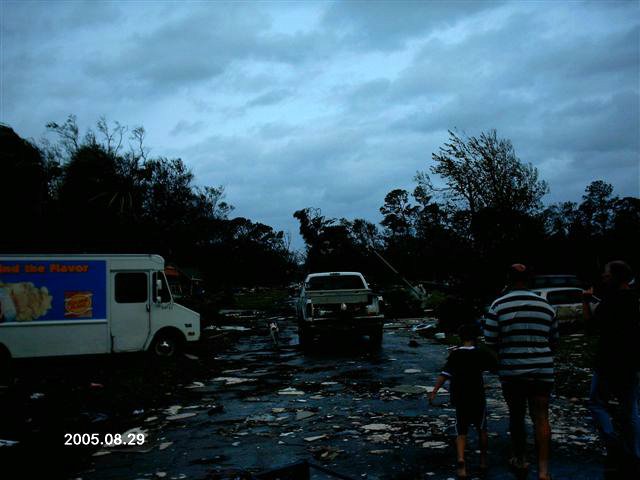
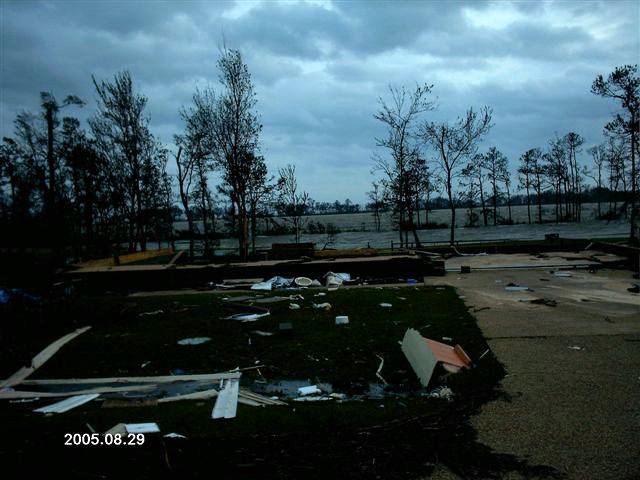
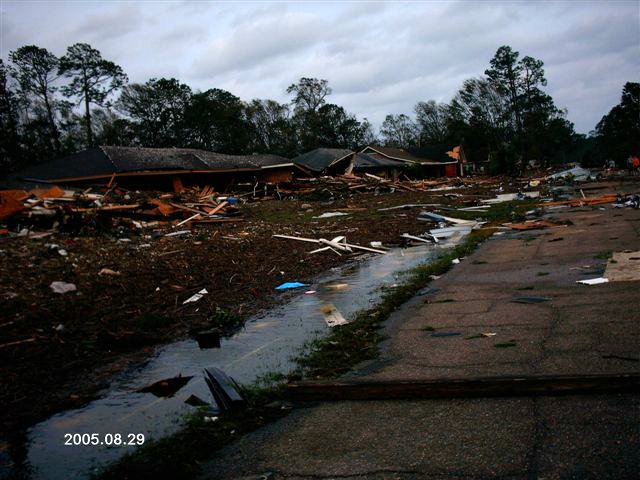
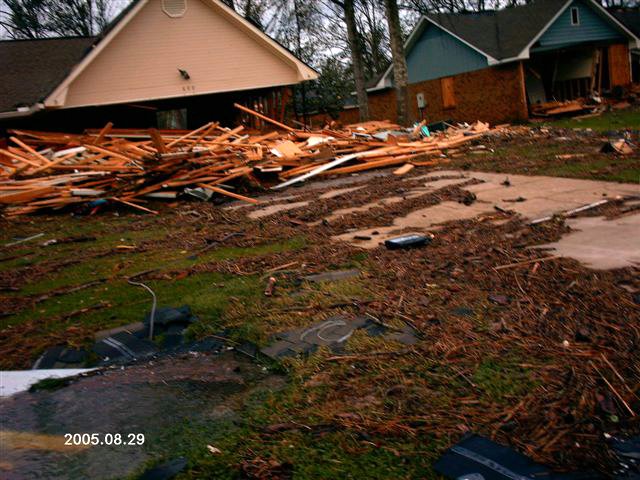
Pictures from Bobbie, taken 8/29-9/1 in Ocean Springs and Moss Point, MS.


Update: Welcome Polipundit readers! Two related posts about Bobbie are here and here.

Thank-you note from Bobbie in Mississippi

Our company brethren in Virginia Beach sent a truck with relief supplies to the Pascagoula area over Labor Day weekend. Bobbie's grandson Nick literally had no clothes of his own after the storm, so Bobbie had asked for clothes for him--a request I relayed to the VA Beach team, and they came through with style!


Kate,

This is the picture of my two little homeless urchins. Right after a bath these are the clothes they put on that came from the NGDMS truck. Nick's are from a book bag that was sent to me from Sarah Cooke. Lexi Girl has on a pair of PJs from that truck with her stuffed animal. (also from the truck) They thought they were something and my Nick said," Look Gran, these are the clothes that your nice friends sent to me"! I don't think those kids know exactly what has happened to them yet!! With the Grace of God and people like all of you, they may never!!

Lexi has on a pair of thong sandals that light up when she walks and does she think she is the Queen of Sheba or what. They even asked me, "Gran don't we have any of our clothes anymore?" I said, No baby, but it's OK, you'll get whatever you need. He just said OK Gran and went about his business as only a child can. Maybe when you see the smiles on the Joys of my Life along with their 4 cousins, how I feel will shine through. I truly hope so. My love and appreciation is felt for all of you everyday. Thank you and Thank you.

Love

Bobbie

Sunday, September 11, 2005

Why I didn't go to Church today

My church was having a 9/11 tribute & remembrance this morning. Being a choir member, I got a copy of the service bulletin last Thursday and read through it. I was by turns angry and appalled when I read the "Litany of Remembrance, Penitence, and Hope", written by The Reverend Eileen W. Lindner and Reverend Marcel A. Welty, National Council of Churches, in 2002.

This post is adapted from a letter I just sent my pastor explaining my absence.

Dear Pastor,

You might have noticed that I was absent from church on Sunday and the 9/11 remembrance. It was a deliberate choice on my part, and you deserve to know why.

I picked up a bulletin on Thursday night before choir practice, and read through the NCC litany. I was absent from church because I could not, in good conscience, participate in that litany. Let me share some of my observations:
We light a candle in penitence, recognizing that we have not done enough to address the sources of anger, hate, dehumanization, rage, and indignation that lead to acts of violence.
This is a noble sentiment if we're talking about the slums of Camden. It has nothing to do with the motivation of jihadists who want to kill us to cleanse the planet for Allah (although it could be argued that the US government has turned a blind eye to Saudi support for the Wahhabbis and their murderous teachings, which are a root cause of today's terrorism). It has nothing to do with official policies in Zimbabwe or Sudan that sanction state-sponsored violence against their own citizens. Go read Victor Davis Hanson, "Keep Quiet And Listen!"
In our sadness, horror and shock we acknowledge that our own fears turned murderous and we have sought revenge, sometimes against even the innocent.
This one I'll grant you since I do remember some incidents against Sikhs, for example. I suspect, however, that the authors of this litany are also casting stones at the military response set in motion to root out the terrorists, their training camps, and the organizations and regimes that supported them. What is easy to forget is that Osama bin Laden and his ideological allies have been active terrorists for decades, even before the first Gulf War brought US troops to Saudi soil. We have finally acknowledged that jihadists are waging war against our civilization (again!), and it's time to fight back (again!). The Army has a comprehensive timeline at http://www.army.mil/terrorism/.
We confess and regret our own anger and recognize its dangers to our spirits, our health, our community, and others.
Anger is a problem only when it festers and has no constructive outlet. I'm angry at the social pathology that was on display in New Orleans after the hurricane, but there's not much I can do about it. I can, however, channel that anger and frustration into positive action locally by participating in our Habitat for Humanity work team, which will help alleviate similar problems that exist in Camden. Rather than induce guilt that we have human emotions, I would much rather you preach anger as a prelude to action. Think about Jesus's anger while overturning the moneychangers' tables in the Temple.
In the midst of the aftermath of the events of September 11th, 2001 we have been tempted to seek only our own good, hear only our own truth, acknowledge only our own suffering.
Even in 2002, this was no longer true. Since then coalition forces have liberated more than 25 million people from the yoke of tyranny in Afghanistan and Iraq. Most recently there were huge outpourings of government and private aid after the tsunami and Hurricane Katrina. Personally, I think the self-centered keening of Cindy Sheehan and her ilk represents a tiny minority of Americans.
We know that peace will come to us and to our children only when the concerns of justice anywhere become the subject of political and social will everywhere, and that no justice leads to no peace.
Western "justice" isn't what the jihadists are aiming for. "Justice" is a loaded term, and the rights we expect as citizens of a modern democracy are quite at odds with the "justice" under Sharia that the Taliban practiced. Are the authors willing to live as Christians under Sharia?
In striving for national security and domestic peace we run the risk of confusing might for right and participating in the very behaviors we condemn.
Which behaviors are those, exactly? Beheading our enemies and broadcasting the video on the Internet? I'm afraid we're more at risk of confusing political correctness with right action. Michelle Malkin pointed out recently how absurd it is for the government to avoid "profiling" in law enforcement while insisting on it for government contracting.
Guard and guide our country that in our search for security we may not trample the rights of the innocent nor disregard the rule of law. Let us not confuse leadership within the global community as the voice for the whole community.
Not a chance of the latter while the Main-stream media is so antagonistic to the Bush Administration.
Repentance means to turn away from wrong deeds. Repentance means choosing instead deeds which require moral restraint, and are more beneficial to all persons who suffer.
Huh? This definition of repentance doesn't match John Wesley's. Even if you go with Webster's first definition of repent, "to turn from sin and dedicate oneself to the amendment of one's life," the authors are still stretching the meaning to relate it to benefiting "all persons who suffer".
We light a candle to light the way to a better world for our children and our children's children, and all the children of God.
Gee, that accomplishes so much.
We recall with joy the unity we felt in the outpouring of help, kindness, thoughtful words and deeds from at home and around the world. We must hold firmly to our unity, borne forward now not of tragedy but of loving kindness. We place fresh confidence in international organizations and conversations that bring the diverse gifts of the world to the problems of poverty, injustice, terror and strife.
Do they remember the celebrations in the streets of Palestine over the fall of the Twin Towers? Unity is over-rated. To wait for total unity is to wait forever. International organizations are only as effective as the people who lead them, and even then, good intentions don't necessarily equate to good results. Since 2002, we've learned a lot about the scandalous Oil-for-Food program at the United Nations, and the evidence that nations on the Security Council itself were profiting from the "sanctions". See Claudia Rosett's latest article.
We long for wise policies that forego short term gain for long term stability, justice and peace.
Sounds like realpolitik. However, realpolitik also means tolerating bad situations in the name of "stability" and "peace", as was done during the Cold War. Stability and lack of armed conflict do not guarantee "justice" nor prosperity nor freedom.
In a time marked by tragedy and war we can hope for an era yet to come in which the slaughter of innocents, greed, the ambitions of power, and cultural and religious bigotries are but memories of a dim and unenlightened past.
The Second Coming of Christ? Somehow, I don't think that's what they mean.
God of the ages, before your eyes all empires rise and fall yet you are changeless. Be near us in this age of terror and these moments of remembrance. Uphold those who work and watch and wait and weep and love. By your Holy Spirit give rise in us to broad sympathy for all the peoples of Your earth. Strengthen us to comfort those who mourn and work in large ways and small for those things that make for peace. Bless the people and leaders of this nation and all nations so that warfare, like slavery before it, may become only a historic memory.
Sympathy is a nice sentiment, but changes little. War is ugly, messy, and destructive, which is why we would rather avoid it. (Consider the Star Trek episode "A Taste of Armageddon"). But there are times when the "peace" of inaction is a worse choice. We ignored the terrorists for decades, which only emboldened them because they perceived us as weak and weak-willed.

I suggest an alternate "Litany for Liberal Christians", something along these lines:
We have focused on our own short-comings as individuals and as a nation with much wailing and gnashing of teeth, but failed to move forward and seek constructive ways to build a better world.

We have been fearful of change, clinging to failed policies and ideologies, unwilling to face realities that don't fit neatly into how we understand the world works.

We have learned the wrong lessons from history, focused on our mistakes and ignored our victories.

We have cheered when cartoon heroes fight evil doers, but declined to call evil by name in the real world. We have apologized to our enemies for our very existence while rebuking our leaders for fighting that evil.

We have been hypocrites, piously intoning our commitment to freedom and self-determination for all people, freedom of religion, economic justice, and women's rights, while castigating those who are working to achieve those lofty ideals in Afghanistan, Iraq, Israel, and elsewhere.

We have been timid in our Christianity, instead making sacrifices at the altars of "multi-culturalism" and "political correctness" that have sapped our strength and undermined the Great Commission to proclaim to the world that Jesus Christ is the Way, the Truth, and the Life.

Great God, forgive us.
Update: Welcome readers from The Anchoress and Desperate Preacher. Thanks for stopping by. You might also be interested in my Labor Day reflections.

Update II: Welcome Brutally Honest readers! And check out the lovely poem Presbypoet left in the comments.

Update III (9/14/05): Welcome Photon Courier readers!

Update IV: See my follow-on post "Overcoming Evil with Good"

Update V (9/20/05): See a related post "Stuck on Stupid"

Tuesday, September 06, 2005

Angels in Disguise

Bobbie S., one of my employees in Pascagoula, has been busy this past week. It took them two days to chop their way back to their neighborhood, where her house was one of the few left standing. With that miracle, she provided shelter to 26 people for several days.

She estimates she has cooked meals for more than 500 people, including the 17 homeless colleagues of her daughter's at the local hospital, and disaster relief workers.

She's been making supply runs to Pensacola, and helping distribute the goods trucked in by our company brethren in Virginia Beach this past weekend.

Bobbie feels that God spared her and her family for a reason, and she has to share what she can with those less fortunate. Life is slowly improving: she got power back at her home this afternoon. However, there is still tremendous need and thousands are homeless in the region.

Some have called her an angel in disguise. She denies that she's an angel, insisting that she's just one of many who are helping their neighbors.

I've asked her to email me stories I can post, so stay tuned.

UPDATE [9/7/05 7:45 pm]: I was on Hugh Hewitt's show this past hour talking about how Bobbie is helping those in greater need than herself. If you'd like to help people like her in the area (and there are many), I suggest working through your churches and synagogues; Hugh is encouraging partnering efforts. Also long term, Habitat for Humanity is launching "Operation Home Delivery" to help people rebuild their homes and their lives.

Monday, September 05, 2005

Labor Day Thoughts

"Labor Day, the first Monday in September, is a creation of the labor movement and is dedicated to the social and economic achievements of American workers. It constitutes a yearly national tribute to the contributions workers have made to the strength, prosperity, and well-being of our country." —— U.S. Department of Labor

Given the lessening clout of the labor unions in general, I propose that we think instead about the labors we have as a country to improve our national well-being. With the desolation wrought by Hurricane Katrina across four states, and the remembrance of the 9/11/01 terrorist attacks next weekend, it seems worthwhile to meditate on where we as a people need to improve.

Several writers have commented on the moral collapse in New Orleans:
This is a meme that will likely continue for a while. I know it's something I've been thinking about this week while looking for some concrete way to turn frustration into positive action.

Although I work in New Jersey, I supervise two employees who live and work in the vicinity of Pascagoula, MS. Both were incommunicado for several nerve-wracking days; one checked in on Wednesday morning, the other on Friday morning. Praise God both are safe and have homes they can live in. Last Wednesday morning, before I knew they were safe, I was anxious and frustrated that I couldn't do anything to help them other than pray and send money (I'm donating via the Salvation Army, UMCOR, and our company relief fund).

Seeing the pictures of the disorder in New Orleans got me thinking, though, because they reminded me of the ghetto riots in the late sixties as well as the riots in Los Angeles following the Rodney King beating trial. The pathology on display in New Orleans is hardly unique to that city, but exists all over the United States, especially in large urban areas.

I happen to live near Camden, where even dedicated social workers and church activists are starting to admit that after forty years and millions of dollars spent on welfare and social services, they haven't made an appreciable difference in the city's slums. I heard one minister comment that the only thing left to do is pray, since nothing they've been doing works anymore —— if it ever did. He went on to say that perhaps the church's efforts (in our case, United Methodist) had gone too far in providing value-neutral assistance just like the government, leaving out the Gospel message and its emphasis on an individual's salvation and accountability. This is pretty much the approach prescribed in the denomination's Social Principles. For example, this paragraph on Poverty states,
Therefore, we do not hold poor people morally responsible for their economic state. To begin to alleviate poverty, we support such policies as: adequate income maintenance, quality education, decent housing, job training, meaningful employment opportunities, adequate medical and hospital care, and humanization and radical revisions of welfare programs.
I sometimes wonder if mainline Protestant professional do-gooders hold poor people responsible for anything: victimhood is writ large in the policies supported above. Note the emphasis on creating utopia through government policies, with no imperative for direction action such as missionary work. I think John Wesley (not to mention William Booth) would be appalled. At least the United Methodist Committee on Relief is rather more pragmatic.

Fortunately, there are direct ways to improve society. My favorite is Habitat for Humanity, with its emphasis on providing a hand up rather than a hand-out. Our church has covenanted with Metro Camden HFH to build a house this year. I intend to be on that work team, as well as supporting it financially.

It's easy to focus on just one catastrophe such as Katrina or the tsunami, and forget to support the day-to-day efforts of charities closer to home. While I was writing checks this week, I also dropped a couple to my local Salvation Army and American Red Cross chapters. Won't you?

P.S. If you'd like some positive news about your tax dollars providing relief on the Gulf Coast, check out DefenseLink.

Thursday, August 25, 2005

Thursday Tidbits

Odds 'n' ends from around the web:
  • Powerline posted excerpts from President Bush's speech in Idaho this week. A sample:

    The stakes in Iraq could not be higher. The brutal violence in Iraq today is a clear sign of the terrorists' determination to stop democracy from taking root in the Middle East. They know that the success of a free Iraq, who can be a key ally in the war on terror and a symbol of success for others, will be a crushing blow to their strategy to dominate the region, and threaten America and the free world. They know that when their hateful ideology is defeated in Iraq, the Middle East will have a clear example of freedom and prosperity and hope. And the terrorists will begin to lose their sponsors and lose their recruits and lose the sanctuaries they need to plan new attacks.

    And so they're fighting these efforts in Iraq with all the brutality they can muster. Yet, despite the violence we see every day, we're achieving our strategic objectives in Iraq. The Iraqi people are determined to build a free nation, and we have a plan to help them succeed. America and Iraqi forces are on the hunt, side-by-side, to defeat the terrorists. And as we hunt down our common enemies, we will continue to train more Iraqi security forces.
    ***
    The battle lines in Iraq are now clearly drawn for the world to see, and there is no middle ground. Transforming a country that was ruled by an oppressive dictator who sponsored terror into a free nation that is an ally in the war on terror will take more time, more sacrifice, and continued resolve. Terrorists will emerge from Iraq one of two ways: emboldened or defeated. Every nation -- every free nation -- has a stake in the success of the Iraqi people. If the terrorists were to win in Iraq, the free world would be more vulnerable to attacks on innocent civilians. And that is why, for the sake of our children and our grandchildren, the terrorists will be defeated. (Applause.)


  • Powerline also posted "Some Thoughts on Casualties in Times of War and Peace"
    Sometimes it becomes necessary to state the obvious: being a soldier is a dangerous thing. This is why we honor our service members' courage. For a soldier, sailor or Marine, "courage" isn't an easily-abused abstraction--"it took a lot of courage to vote against the farm bill"--it's a requirement of the job.

    Even in peacetime. The media's breathless tabulation of casualties in Iraq--now, over 1,800 deaths--is generally devoid of context. Here's some context: between 1983 and 1996, 18,006 American military personnel died accidentally in the service of their country. That death rate of 1,286 per year exceeds the rate of combat deaths in Iraq by a ratio of nearly two to one.

    That's right: all through the years when hardly anyone was paying attention, soldiers, sailors and Marines were dying in accidents, training and otherwise, at nearly twice the rate of combat deaths in Iraq from the start of the war in 2003 to the present. Somehow, though, when there was no political hay to be made, I don't recall any great outcry, or gleeful reporting, or erecting of crosses in the President's home town. In fact, I'll offer a free six-pack to the first person who can find evidence that any liberal expressed concern--any concern--about the 18,006 American service members who died accidentally in service of their country from 1983 to 1996.

    The statistics from the "Atlas of Injuries in the U.S. Armed Forces" (AUG 1999) indicate that accidental deaths counted weren't necessarily in the line of duty. Rather, the military keeps track of off-duty incidents as well; reducing all causes of death and injury means improved readiness and a better ROI for our tax dollars. The Navy, for example, is pushing a Designated Driver program called the HERO Campaign, which is just one of many ongoing safety-related efforts.

  • Powerline also pointed me to Katherine Kersten's touching column in the StarTrib, "In Iraq, Grace takes amazing hold":

    Pastor Ghassan Thomas was overjoyed on April 9, 2003, when coalition forces toppled Saddam Hussein. For four years, in the face of relentless persecution, he had operated an underground Christian church of about 50 members in the heart of Baghdad.

    Saddam's police had tortured him repeatedly, Thomas says -- beating him, suspending him from a ceiling fan and attaching electrodes to his tongue.

    Though Saddam's fall brought an end to official persecution, it also brought challenges. The living quarters where Thomas' fledgling flock had worshipped couldn't accommodate his swelling congregation, and he lacked resources to address their daunting needs.

    As his frustration mounted, Thomas says, "I prayed to God for a sister church to stand with me and help me."

    The answer to Thomas' prayers came from half a world away: Eden Prairie, Minn.

  • If you're looking for a roundup of good news from Iraq, check out All Things Conservative and the official Pentagon roundup. Chrenkoff is winding down his blog now that he has a new job, but promises another roundup next Monday.

  • John Fund of the Wall Street Journal was on Hugh Hewitt's show the other night, discussing his piece "Resurrecting Jim Crow for Political Gain," among other topics. He reported on a recent rally in Atlanta on the occasion of the 40th anniversary of the Voting Rights Act. The lede:

    The Voting Rights Act, whose 40th anniversary we celebrate this month, has helped minorities elect 81 sitting members of Congress and thousands of local officials. But the rally civil rights groups held in Atlanta earlier this month to push for extension of the act's key temporary provisions downplayed those gains and instead pushed wild claims that some state laws requiring an ID to vote are the functional equivalent of Jim Crow poll taxes.

    Both Judge Greg Mathis, the star of a syndicated courtroom TV show, and California Rep. Barbara Lee claimed that the last two presidential elections had been "stolen." Judge Mathis told the rally Republican leaders "need to be locked up because they're all criminals and thieves." Other speakers claimed Georgia's new photo ID law would suppress poor and elderly minority voters who might lack such a document. When the bill passed the Georgia House in March, black legislators sang slave songs and one even slammed a prisoner's shackles on the desk of the sponsor.

    Juan Williams, a National Public Radio correspondent and author of "Eyes on the Prize: America's Civil Rights Years," is "stunned" by such vituperation. He told Fox News that it is "reacting to devils that have been slain 40 years ago." He says that "in service to having no fraud elections, I think you could say to people, go and get a legitimate ID. I don't think that's too much to ask."

    Andrew Young, the former Atlanta mayor and U.N. ambassador who spoke at the rally, believes that in an era when people have to show ID to rent a video or cash a check "requiring ID can help poor people." He noted that Georgia is deploying a mobile bus to issue voter IDs and allowing groups like the NAACP to arrange for it to go to specific sites.


  • Speaking of voter fraud, NY Times columnist Paul Krugman has been factually challenged in a couple of recent op-eds about the Florida recounts in 2000. As The American Thinker reports:
    Paul Krugman, the former Enron advisor, New York Times op ed columnist, and presumably in his spare time, “educator” at Princeton, has made a habit of distortion, and half truths in his twice-weekly columns in the “paper of record.” Several website have sprung up to deconstruct each Krugman column,and others respond to specific errors, which are routine. But Krugman's column on Friday, August 19 marks a remarkable descent into outright dishonesty, a new low. What is most astounding is that the dishonesty involves Krugman's deliberately mistaken interpretration of a study in which his own paper, the New York Times, was a participant, and from which the Times ' reporters drew entirely different conclusions from those which Krugman trumpeted in his article.
    A follow-up commentary is here. (Hat tip Patterico). More dissecting at Powerline and NRO.

  • One simmering scandal you may not have read about (especially if your main news source is the New York Times) concerns a $800k "loan" from the Gloria Wise Boys & Girls Club to the corporate parent of Air America. The New York City Department of Investigations is investigating Gloria Wise for misuse of government grants in making the loan. Air America is being sued for non-payment of air time, with allegations of fraudulent corporate maneuvers. All the earmarks of a classic whodunit! Key reports are the following:
  • The latest chapter in the ongoing "Able Danger" controversy is Senator Specter's memo to the FBI's Director seeking information (via Captain's Quarters). Captain Ed has run a series of posts on Atta and Able Danger this month, along with various AQ intelligence reports from overseas, such as France and Germany. He has a roundup post today with more links, "Able Danger: The Strange Spanish Interlude."

Friday, August 19, 2005

Rocket attacks in Jordan

This morning, several rockets were fired in the direction of two US Navy ships in port at Aqaba, Jordan. They missed the USS Kearsarge and USS Ashland, but killed a Jordanian soldier.

While the AP story has been getting more detailed throughout the day, the blogosphere is providing context, connecting dots, and raising questions. Some salient posts:

Sunday, June 05, 2005

Quick reads

Some of the articles I found interesting this week:

  • A number of bloggers recommended Charles Krauthammer's article in Time Magazine, "In Defense of Certainty", which was in the June 1st issue.

    The Op-Ed pages are filled with jeremiads about believers--principally evangelical Christians and traditional Catholics--bent on turning the U.S. into a theocracy. Now I am not much of a believer, but there is something deeply wrong--indeed, deeply un-American--about fearing people simply because they believe. It seems perfectly O.K. for secularists to impose their secular views on America, such as, say, legalized abortion or gay marriage. But when someone takes the contrary view, all of a sudden he is trying to impose his view on you. And if that contrary view happens to be rooted in Scripture or some kind of religious belief system, the very public advocacy of that view becomes a violation of the U.S. constitutional order.

    What nonsense. The campaign against certainty is merely the philosophical veneer for an attempt to politically marginalize and intellectually disenfranchise believers. Instead of arguing the merits of any issue, secularists are trying to win the argument by default on the grounds that the other side displays unhealthy certainty or, even worse, unseemly religiosity.

  • Neo-Neocon takes a look at "The International Criminal Court as theater." She concludes:
    The international justice system regarding war crimes is highly subject to abuse by special interest groups. In a sense, it is a polite fiction that such a system can exist and be meaningful, because it lacks the true characteristics of a functioning legal system. As such, we are correct to have opted out of the game.
  • The Anchoress writes, "The Holy Spirit stirs, then ravishes:"

    We read, increasingly, a tone of wonderment in the press as reporters who have long-ago shrugged off religion as unsophisticated and tres uncool discover that people - even young people - not only are seeking faith, but embracing it and commiting to it, and living it. And yes, loving it.

    There is so much going on. There has been so much going on for a while, but it has come into sharper focus, I think, since the death and funeral of John Paul the Great and the election of his successor, Benedict XVI.

    Something is stirring.

    The Holy Spirit is never static, she is ever at work, ever on the move.

  • Dr. Sanity looks at "The Left's Pervasive Tyranny:"
    [T]he Left has made it their primary modus operandi to use the force of the government to give clout to their cultural, social, political and moral and quasi-religious beliefs in all areas. Of course, they do it because they understand that they are much more knowledgable than you or I are about what is right.

    It is the pervasive tyranny of the elitist.
  • Hurl's Blog muses on the ramifications of Bush-bashing in "Thanks Bush:"

    It seems we have come to a place in the world where two scapegoats exist – Jews and Bible-believing Christians. One group is generally represented by Israel, the other by America - described by radical Islam as the “Little Satan” and the “Great Satan” respectively. There also seems to be an unwritten alliance of sorts between radical Islam and those on the left who regularly bash, ridicule and demonize Bible-believing Christians as well as are becoming increasingly hostile to Israel. They share the same enemies…..

  • And for policy wonks, The Employment Policy Institute published a paper by Dr. Aaron Yelowitz - University of Kentucky, and Dr. Richard Toikka - Lewin Group, entitled "Effective Tax Rates and the Living Wage:"
    Overall, the authors have found that living wage ordinances do little to actually increase the standard of living for low-income families. The $55-a-month increase in total family earnings represents a less than 2 percent increase for the average family. In terms of an increase in earnings, the $16-per-month increase represents an increase of approximately one-half of one percent. The authors state, “a reasonable reading of our results is that the living wage has a limited capability in improving the economic status of the poor.” This limited capability is important because decades of studies clearly show that mandated wage floors create disemployment effects—particularly for the low-skilled employees these laws are intended to help. Pushing the intended beneficiaries out of a job while providing minimal benefits to remaining employees makes living wage ordinances an ineffective anti-poverty policy.
Of course, data alone won't stop the politicians any time soon...

Monday, May 16, 2005

Monday Notes

I'm back from a quick vacation over the weekend, visiting my sister and her husband in Massachusetts. While I was there, I read most of The Tipping Point: How Little Things Can Make a Big Difference by Malcolm Gladwell, which was on their coffee table. He has an interesting thesis, explaining sudden societal changes in terms of epidemics. I need to get my own copy so I can finish reading it!

I took them out to dinner Friday night at Blue Ginger in Wellesley, which is owned by Chef Ming Tsai. While pricey, with entrees at $21-35, it was worth every penny! The food was delicately flavored and presented beautifully by the attentive staff. If you're in the area, I recommend it for an exceptional treat. They take reservations, but also set aside tables for walk-ins.

Last Tuesday, Robert Plant's [warning: that site is a bandwidth beast!] new album "Mighty Rearranger" came out in the US. I had put it on my "must-buy" list when I first heard the single "Shine It All Around" a couple of months ago, so I hied myself to Best Buy on Wednesday and bought the last copy in the rack. I've been listening to it—some would say OD'ing—ever since, especially on the drive to and from MA. One thing I haven't seen any mention of is his use of Christian imagery in several songs. Of course, I might be reading too much into lyrics like this from "Shine It All Around":
This is the heart of the man
This is the heart of the matter [man?]
Break a little bread now, spread it all around
Perhaps it just goes to an old-fashioned liberal British education where students read the classics? At any rate, I get a charge every time I hear the song. The rest of the album is musically diverse and I discover something new in every listening, whether it's harmony, lyrics, or rhythms. A reasonably friendly fan site is at Robert Plant Homepage.

Over at the NRO Corner, a couple of items caught my attention:
  • IRANIAN REVELATIONS [Michael Ledeen] posts a remarkable email that purports to translate parts of a letter to "Rafsanjani ... written by a Karaj based cleric. He says in the letter that he is ill and near death, so presumably that is what has given him the extra ordinary courage needed to write this letter." Ledeen comments, "I think it is enormously important, because it shows the depth of the hatred of the regime from a leading Shi'ite mullah, in a degree of detail I think most of us would find amazing. And it also provides very useful information about the official presidential candidate, Rafsanjani, who is often described as a "moderate.""
  • THEOCRATS AND ALL THAT [Andrew Stuttaford] highlights an article by Mark Lilla in the NYT, as well as a book review in the Financial Times, that is "a nice little example of the way in which liberalism has swapped reason for dreams, fantasy and paranoia."
OpinionJournal, meanwhile, posted a prescient WSJ editorial "Liberal Fundamentalism: Who are the intolerant extremists?" that was originally published on Sept. 13, 1984. It opens,

We have been following the extensive theological commentary in the press on the subject of politics and religion in the current presidential campaign. It might not otherwise have occurred to us that so many editorialists and columnists harbored so many deep, pent-up opinions on religious worship, voluntary school prayer or Christian fundamentalism.

What we have been looking for but have so far missed in this great awakening of religious writing is a short sermon on the subject of liberal fundamentalism. And so in the spirit of Samuel Johnson, who once wrote homilies for his church pastor so as not to fall asleep during Sunday services, we would like to offer a few thoughts on what has been far and away the most messianic religion in America the past two decades--liberal politics.

Plus ça change, plus ça même.

John Hinderocker (of Powerline) has a column up at The Weekly Standard that looks into the oddities of the UN's proposed $1.2 Billion renovation project. The verdict?

It appears there are serious questions about the U.N.'s renovation project. Depending on which assumptions one accepts about cost and square footage, anywhere from $500 million to $1 billion in expense is unaccounted for. Given the U.N.'s history, is there any reason to doubt that the costs projected by that organization include substantial sums representing, as Trump put it, incompetence or fraud? Given what we know about the oil-for-food program, is there any reason to trust the U.N.'s business or accounting practices?

American taxpayers have a legitimate interest in knowing the answers to these questions. The renovation is to be financed by a low-interest, 30-year, $1.2 billion loan from the U.S. government. (Kofi Annan's original request for an interest-free loan was turned down.) And, of course, the loan will then be repaid largely by American taxpayers, who foot a little over 20 percent of the U.N.'s bills.

A few congressmen and senators have finally begun to ask whether the U.N. building project is a boondoggle. It's about time.

Also check out the Powerline post: "Anything goes if you're planning to attack believing Christians." They summarize a Robert Novak piece, noting that "NARAL Pro-Choice America hired two operatives to obtain and probe the financial disclosure records of 30 appellate court judges considered potential nominees for the Supreme Court," a move that Novak terms "a fishing expedition to find irregularities in potential selections for the Supreme Court." Not a promising development, to say the least.